Last updated June 3, 2026
One in three adults over 65 has measurable hearing loss — and most wait seven years before doing anything about it. That gap costs people relationships, confidence, and mental sharpness. The good news: the best AI hearing aids 2026 has to offer are genuinely better than anything available five years ago. The bad news: the market is flooded with overpriced gadgets, misleading claims, and fine print that can trip you up.
This guide cuts through all of that. Plain English. Honest assessments. Real downsides included.
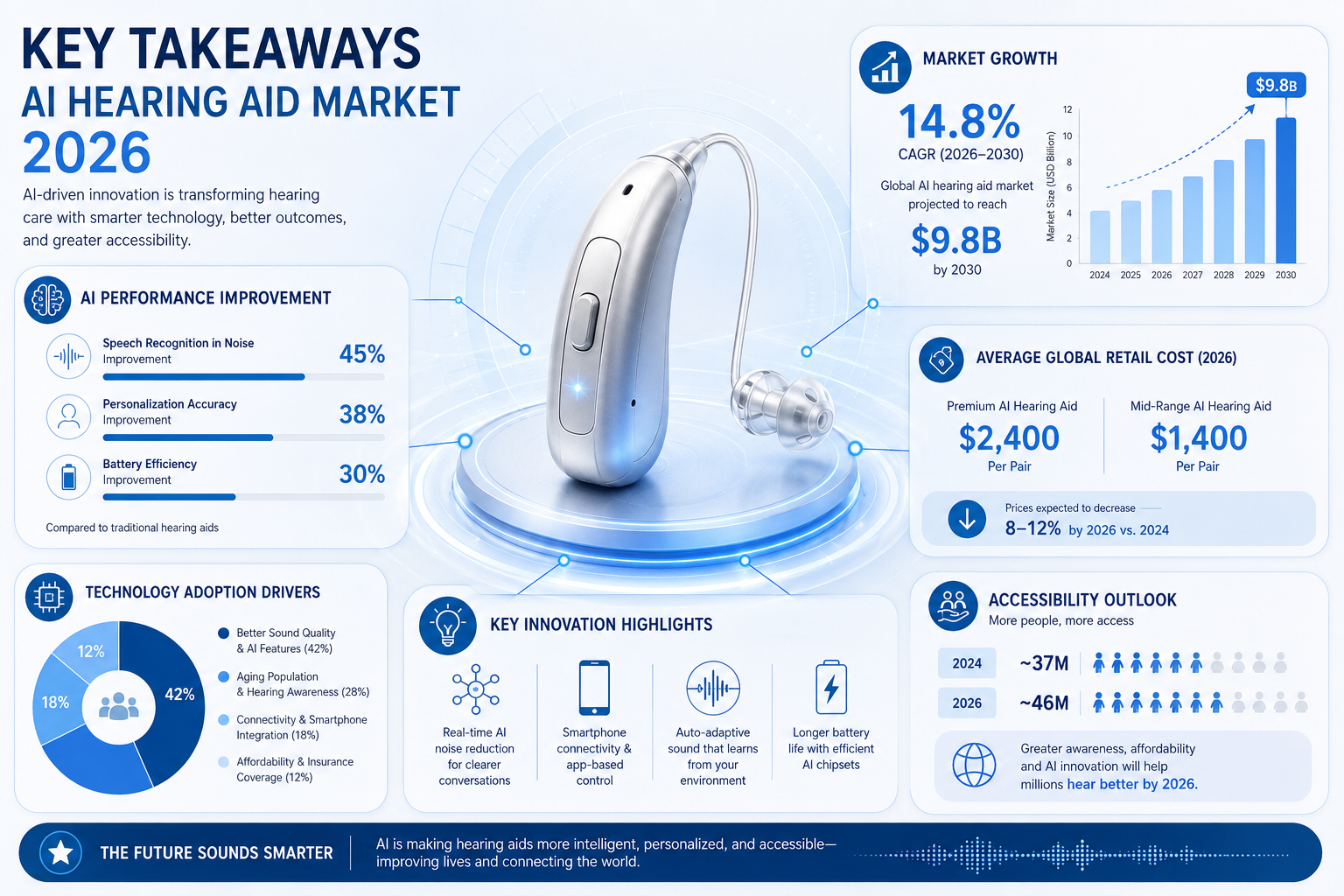
Key Takeaways
- AI hearing aids now adapt in real time to your sound environment — no manual adjustments needed.
- Over-the-counter (OTC) options have made quality hearing aids accessible for under $1,000 — sometimes well under.
- Prescription AI aids still lead on performance for moderate-to-severe hearing loss, but cost $3,000–$7,000+.
- Rechargeable batteries and Bluetooth streaming are now standard on most quality models.
- The biggest mistake seniors make is buying on price alone — fit, support, and trial periods matter just as much.
What “AI” Actually Means in a Hearing Aid (And What to Watch Out For)
The word “AI” gets slapped on everything these days. In hearing aids, it actually means something specific — and useful.
Traditional hearing aids amplify sound. All sound. That’s why they made crowded restaurants feel like standing inside a jet engine.
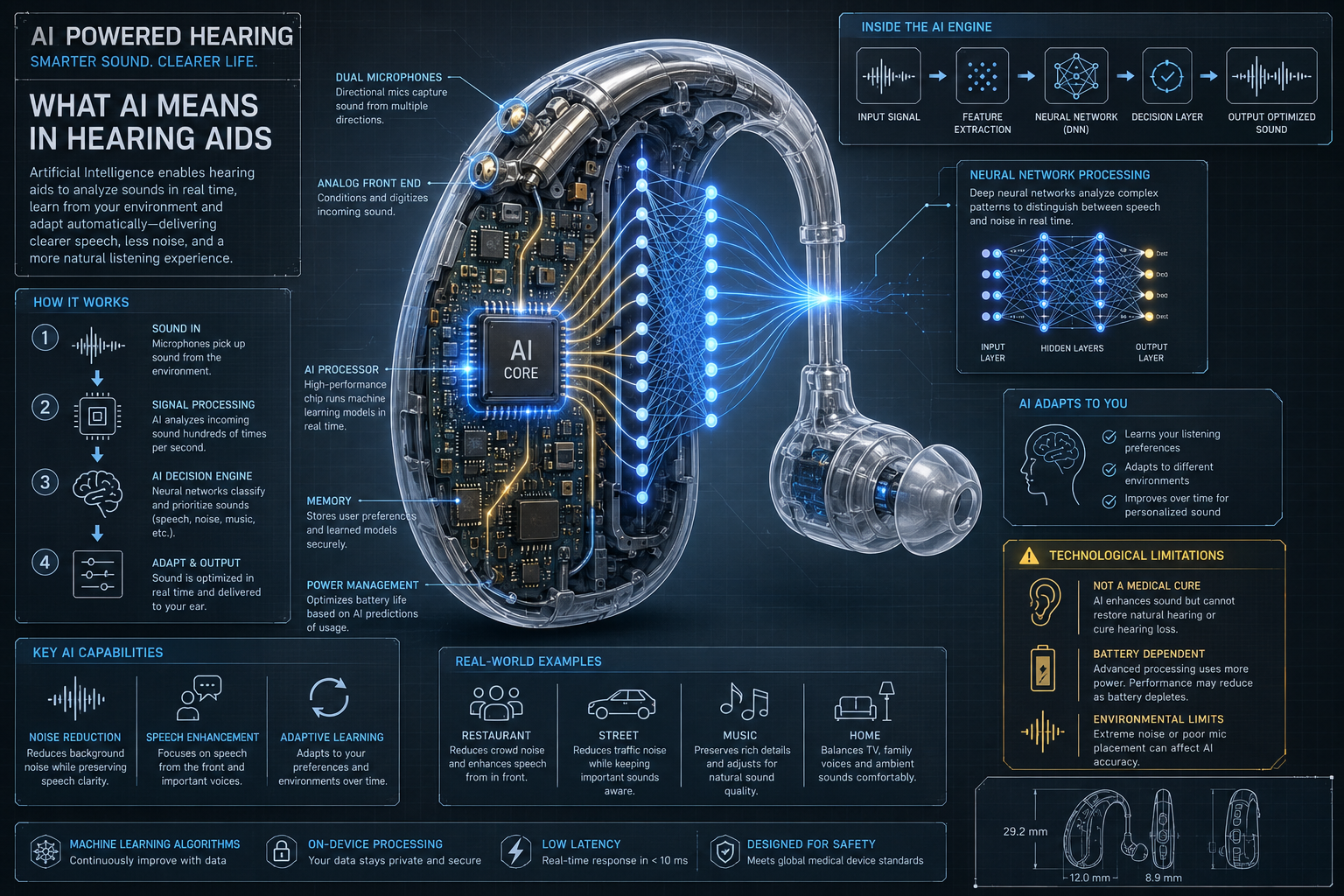
AI-powered hearing aids do something smarter. They analyze your sound environment dozens of times per second, identify what’s speech and what’s noise, and adjust amplification automatically. Some models learn your preferences over time. Others can distinguish between a crowded restaurant, a quiet living room, and a windy street — and switch settings without you touching a thing.
That’s the real promise. And for most people with mild to moderate hearing loss, it delivers.
What to watch out for:
- Some brands label basic digital processing as “AI.” It isn’t. Real AI hearing aids use machine learning chips — look for brands that specify neural processing or deep neural network technology.
- AI features drain batteries faster. If a device claims AI and 5-day battery life, read the fine print carefully.
- More features don’t always mean better hearing. If you’re not tech-comfortable, a simpler device with good sound quality may serve you better.
“The best hearing aid is the one you’ll actually wear every day.” — A truth every audiologist agrees on.
The Best AI Hearing Aids 2026: Top Models Honestly Reviewed
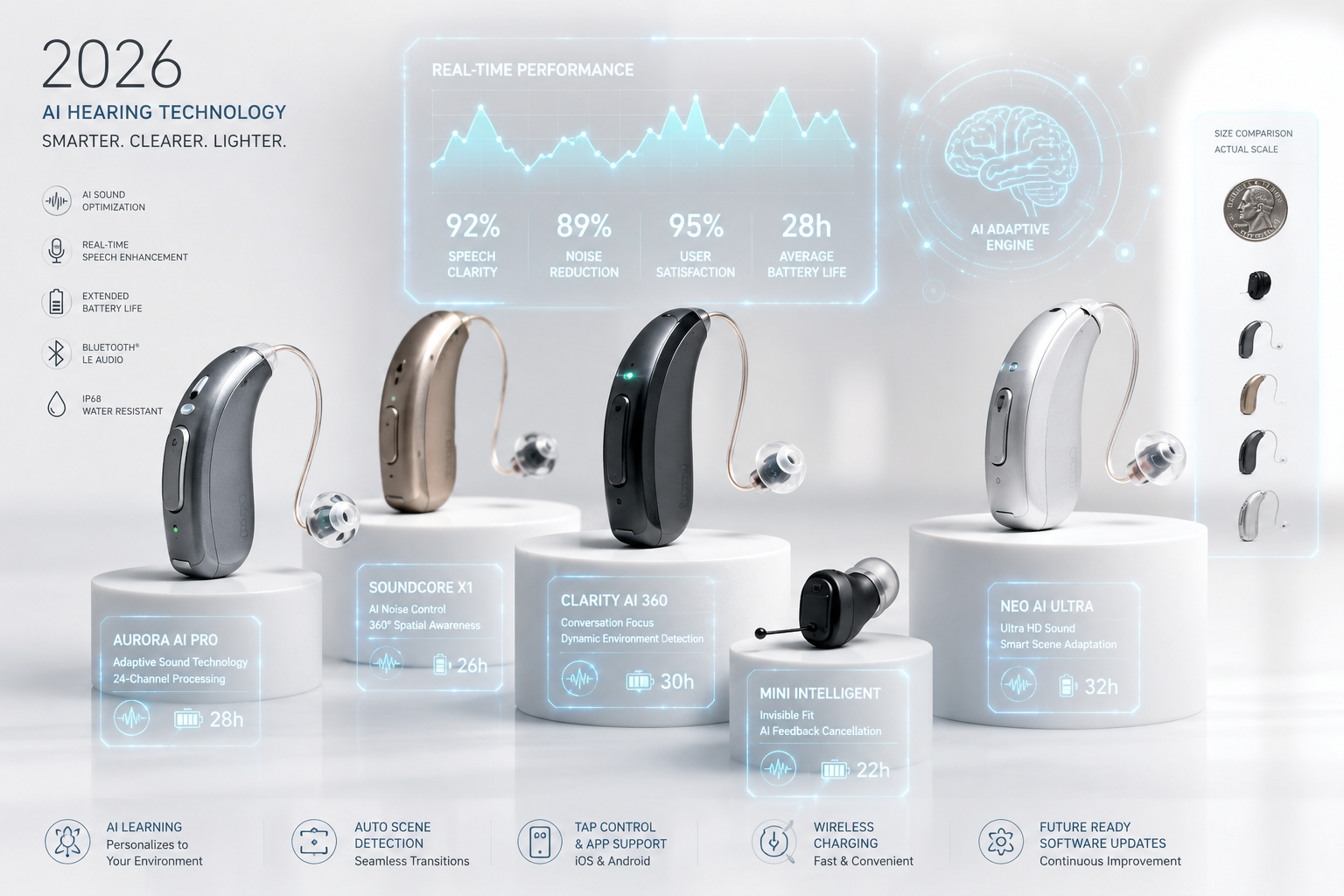
Here’s where the rubber meets the road. These are the models worth your attention in 2026, broken down by category.
🏆 Best Overall: Starkey Genesis AI
Who it’s for: Adults with mild to severe hearing loss who want the most advanced AI available.
Starkey is an American company, and the Genesis AI is their flagship. It uses an onboard neural processing chip that analyzes 55 million data points per hour. In plain English: it’s constantly learning and adjusting to your specific hearing environment.
Standout features:
- Fall detection and alerts sent to a family member’s phone
- Edge Mode+ — tap your ear to instantly optimize for a difficult listening situation
- Thrive app for iPhone and Android with detailed hearing health tracking
- Rechargeable, with a full day’s use per charge
Honest downside: You need a hearing care professional to fit and program it. This is a prescription device. Expect to pay $4,500–$7,000 for a pair, depending on your provider.
Bottom line: If you have significant hearing loss and want the best technology available, Starkey Genesis AI earns its reputation. Just budget for the full cost, including follow-up appointments.
💰 Best Value Prescription AI: Phonak Audéo Sphere Infinio
Who it’s for: Adults who want premium AI performance without paying for the most expensive tier.
Phonak’s Sphere Infinio introduced a dual-chip architecture — one chip handles traditional sound processing, a second chip handles AI. The result is faster, more accurate background noise separation than single-chip competitors.
Standout features:
- Stellar performance in noisy environments (restaurants, family gatherings)
- Universal Bluetooth — connects to both iPhone and Android without workarounds
- AutoSense Sky AI — automatically detects and adapts to 200+ listening environments
- Available in rechargeable and traditional battery versions
Honest downside: The companion app is functional but not as polished as Starkey’s Thrive. Some users find it clunky at first.
Bottom line: For most adults with moderate to severe hearing loss, Phonak Audéo Sphere Infinio delivers excellent real-world performance. It’s a strong choice if you spend a lot of time in noisy social settings.
📱 Best OTC AI Hearing Aid: Jabra Enhance Plus (Updated 2026)
Who it’s for: Adults with mild to moderate hearing loss who want quality without a prescription or audiologist visit.
The OTC hearing aid category opened up in the U.S. in 2022, and Jabra has consistently led it. The updated 2026 version adds improved AI noise filtering and a more refined app experience.
Standout features:
- No audiologist required — self-fit using the app’s hearing test
- True wireless earbuds that double as hearing aids (discreet design)
- Solid Bluetooth audio for calls, music, and TV
- Price: approximately $800 for a pair
Honest downside: OTC devices are not appropriate for moderate-to-severe or severe hearing loss. If your hearing loss is significant, an OTC device will frustrate you. Also, the earbud design isn’t comfortable for everyone — especially those with smaller ear canals.
Bottom line: If your hearing loss is mild and you’re hesitant to commit to a full audiologist process, Jabra Enhance Plus is a legitimate starting point. Tested and approved by multiple independent reviewers.
🔋 Best for Battery Life: ReSound OMNIA
Who it’s for: Adults who travel frequently or don’t want to worry about daily charging.
ReSound OMNIA uses a hybrid processing approach — AI handles complex environments, conventional processing handles simpler ones — which extends battery efficiency significantly.
Standout features:
- Up to 30 hours on a single charge (with streaming)
- Excellent directional microphone system
- Strong Bluetooth connectivity with Made for iPhone and Android compatibility
- ReSound Smart 3D app is one of the most senior-friendly interfaces available
Honest downside: The AI noise reduction, while good, doesn’t quite match Starkey or Phonak in extremely loud environments. If you’re regularly in very noisy settings, this matters.
Bottom line: For travelers, active retirees, or anyone who finds daily charging annoying, ReSound OMNIA is worth serious consideration.
Quick Comparison Table
| Model | Type | AI Level | Price Range | Best For |
|---|---|---|---|---|
| Starkey Genesis AI | Prescription | ⭐⭐⭐⭐⭐ | $4,500–$7,000 | Advanced hearing loss |
| Phonak Audéo Sphere Infinio | Prescription | ⭐⭐⭐⭐⭐ | $3,500–$6,000 | Noisy environments |
| Jabra Enhance Plus | OTC | ⭐⭐⭐ | ~$800 | Mild loss, budget-conscious |
| ReSound OMNIA | Prescription | ⭐⭐⭐⭐ | $3,000–$5,500 | Battery life, travelers |
How to Choose the Right AI Hearing Aid for You in 2026
Don’t start with the product. Start with your hearing.
Step 1: Get a proper hearing test. A licensed audiologist can tell you exactly what type and degree of hearing loss you have. This determines whether you need a prescription device or whether an OTC option can work. Many audiologists offer free or low-cost initial screenings.
Step 2: Know your lifestyle.
- Spend a lot of time in restaurants and social settings? Prioritize noise reduction.
- Mostly at home watching TV? Bluetooth streaming and comfort matter more.
- Travel frequently? Battery life and durability move up the priority list.
Step 3: Insist on a trial period. Any reputable hearing aid provider — including OTC brands — should offer at least a 30-day trial with a money-back guarantee. If they don’t, walk away.
Step 4: Factor in the total cost. Prescription hearing aids often come bundled with follow-up appointments, adjustments, and cleaning. OTC devices don’t. Neither model is automatically cheaper when you add up the real costs over three years.
Step 5: Check what Medicare and insurance cover. Medicare Part B does not cover hearing aids as of 2026, but some Medicare Advantage plans do. Check your specific plan. Some states have programs that help lower-income seniors with costs.
What Seniors Say: Common Complaints to Know Before You Buy
These are the most frequently reported issues — not from marketing materials, but from actual users:
- “It whistles when I hug someone.” This is called feedback. Better AI models suppress it automatically. Ask specifically about feedback cancellation.
- “The app is too complicated.” Some companion apps are genuinely senior-unfriendly. ReSound and Starkey tend to score better here.
- “It fell out during exercise.” Fit matters enormously. Always try before you commit.
- “The sound felt tinny at first.” This is normal. Most audiologists recommend a two-to-four week adjustment period.
Conclusion: The Bottom Line on Best AI Hearing Aids 2026
Hearing aids have crossed a real threshold. The best AI hearing aids 2026 offers aren’t just louder — they’re smarter. They adapt. They learn. They make difficult listening situations manageable in ways that weren’t possible even three years ago.
But the technology is only part of the equation.
Your next steps:
- Schedule a hearing test with a licensed audiologist — not a hearing aid salesperson.
- Match the device to your actual hearing loss level — don’t overbuy or underbuy.
- Demand a trial period before committing any significant money.
- Check your Medicare Advantage plan for any hearing aid benefits.
- Start with one of the four models reviewed here — they’re honestly reviewed, not paid placements.
Hearing loss is common. Doing nothing about it doesn’t have to be. The technology is there. Now it’s just about finding the right fit — literally and figuratively.