Last updated June 3, 2026
“

Nearly 57 million Americans are over 65, and a growing number of them are earning real supplemental income online — not through scams or get-rich-quick schemes, but through affiliate marketing done right. If you’ve been curious about how seniors can make money with affiliate marketing, this guide gives you the honest picture: what it is, what it takes, what it pays, and what to watch out for.
No hype. No pressure. Just the facts.
Key Takeaways
- Affiliate marketing is legitimate — you earn a commission by recommending products or services you genuinely believe in.
- Your life experience is an asset, not a liability. Decades of knowledge in health, travel, finance, or hobbies make you credible.
- You don’t need to be tech-savvy to start, but you do need patience and consistency.
- Video content and niche blogging are the two most accessible entry points for seniors in 2026.
- FTC disclosure is not optional — failing to disclose affiliate relationships can result in real penalties.
What Affiliate Marketing Actually Is (Plain English)
Affiliate marketing means you recommend a product or service, someone buys it through your unique link, and you earn a commission. That’s it.
You don’t hold inventory. You don’t handle customer service. You don’t process payments. The company does all of that. Your job is to connect the right people with the right products — honestly.
Here’s a simple example:
You write a blog post reviewing a blood pressure monitor you actually use. You include a link to buy it on Amazon. A reader clicks your link and purchases it. Amazon pays you 3–8% of the sale. You never touch the product again.
That’s affiliate marketing in plain English.
The commissions vary widely. Physical products on Amazon might pay 3–8%. Software subscriptions can pay 20–40% recurring monthly commissions. Some health and wellness programs pay flat fees of $50–$200 per referral.
Why 2026 Is a Realistic Time for Seniors to Start
The affiliate marketing landscape has shifted in ways that actually favor older adults.
Search engines and social media platforms now prioritize genuine expertise and authentic experience over slick production values [1]. A 68-year-old who has managed arthritis for 20 years and recommends a joint supplement has more credibility than a 25-year-old influencer who has never had a sore knee.
That’s a real advantage. Use it.
A few facts worth knowing:
- Video content is projected to drive 55% of all affiliate traffic in 2026 [2]. Short product review videos on YouTube are accessible even to beginners.
- AI tools now help with writing, editing, and even video scripting — reducing the technical burden significantly [3].
- Social commerce — buying directly through social media platforms — is growing fast, giving you more places to share affiliate links [4].
💡 The bottom line on timing: The tools are easier, the platforms reward authenticity, and your experience has genuine market value. The window is open.
How Seniors Can Make Money With Affiliate Marketing: Choosing Your Niche
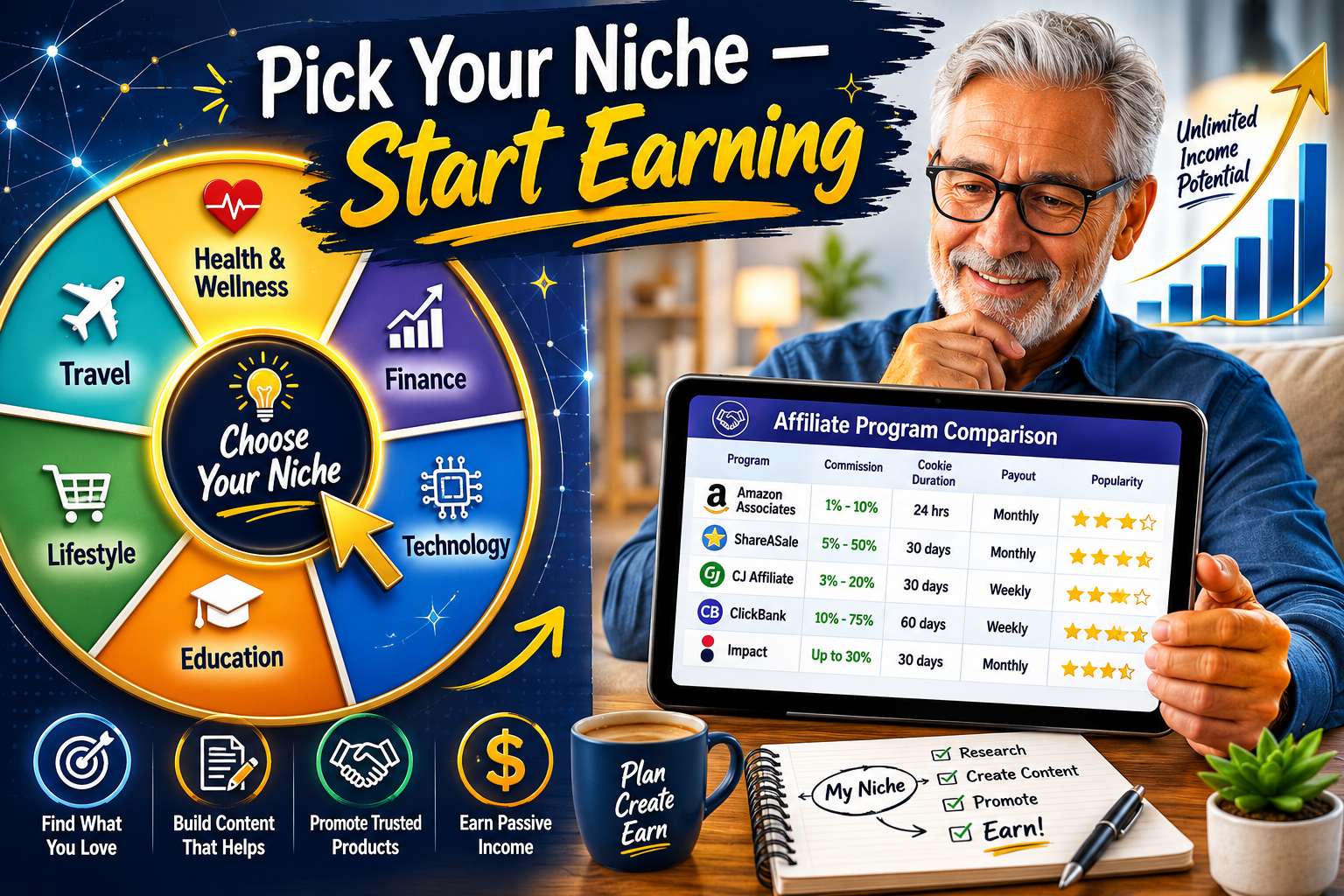
The single most important decision you’ll make is choosing a niche — a focused topic area. Spreading yourself thin across dozens of topics is a fast path to burnout and zero income.
Pick something you already know.
Here are niche categories that work especially well for seniors:
| Niche | Why It Works | Example Products |
|---|---|---|
| Health & Wellness | High demand, personal credibility | Supplements, medical devices, fitness gear |
| Personal Finance | Retirement expertise resonates | Budgeting apps, investment platforms, insurance |
| Travel for Seniors | First-hand experience is gold | Travel insurance, luggage, booking platforms |
| Gardening & Home | Huge hobby market | Tools, seeds, smart home devices |
| Technology for Seniors | Peer-to-peer trust is powerful | Tablets, hearing aids, safety devices |
| Grandparenting | Emotionally engaged audience | Toys, books, family activity kits |
Targeting a specific niche leads to higher commissions and more loyal audiences [5]. A blog called “Tech Made Simple for Seniors Over 60” will outperform a generic tech blog every time — because it speaks directly to a defined group of people.
What to watch out for: Avoid niches you don’t actually know or care about. Readers can tell when content is hollow. Hollow content doesn’t rank, and it doesn’t convert.
How Seniors Can Make Money With Affiliate Marketing: Step-by-Step Setup
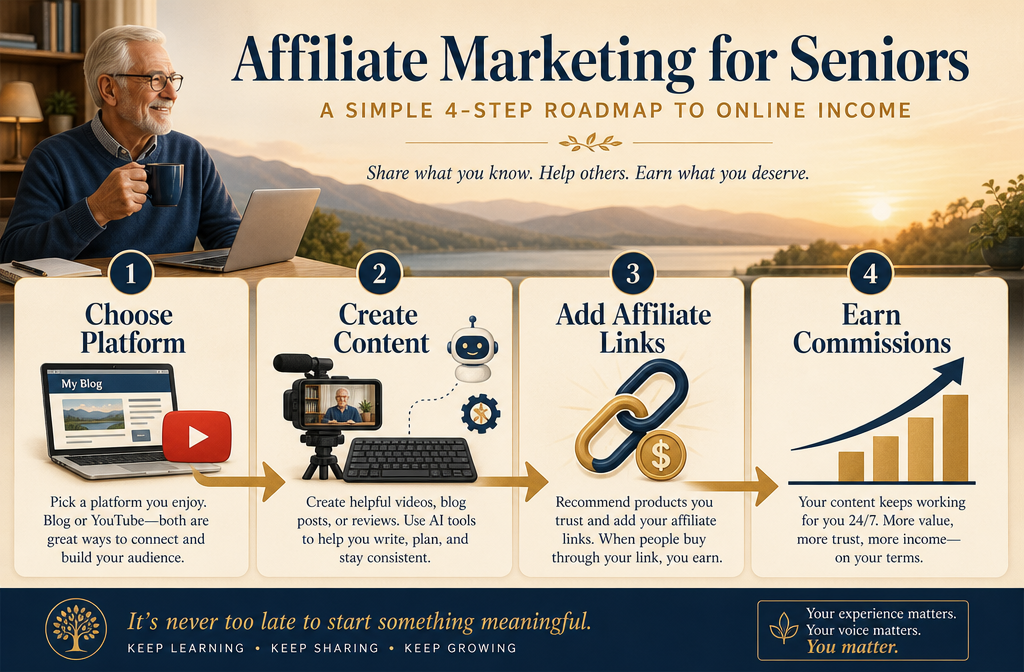
Getting started doesn’t require a computer science degree. Here’s a realistic path.
Step 1: Choose Your Platform
You need a place to publish content and share affiliate links. The main options:
- A blog or website — Best for long-term, search-engine-driven traffic. WordPress is the standard. Costs roughly $5–$15/month for hosting.
- YouTube channel — Free to start. Video reviews and tutorials perform well. You don’t need a professional camera; a modern smartphone works.
- Email newsletter — Builds a direct relationship with your audience. Tools like Mailchimp have free tiers.
Honest downside: Building traffic takes time. Expect 6–12 months before you see meaningful income. Anyone promising faster results is selling something.
Step 2: Join Affiliate Programs
Once you have a platform (even a basic one), apply to affiliate programs. Start with these:
- Amazon Associates — Easy to join, millions of products, lower commissions (3–8%)
- ShareASale — Connects you with hundreds of brands across many niches
- Commission Junction (CJ) — Similar to ShareASale, strong brand selection
- Direct brand programs — Many companies run their own affiliate programs. Search “[brand name] + affiliate program.”
Step 3: Create Honest, Useful Content
This is where your experience pays off. Write or record content that genuinely helps people make decisions.
- Product reviews (be honest about flaws)
- Comparison articles (“Product A vs. Product B”)
- How-to guides that naturally reference products
- “Best of” lists for specific needs
AI writing tools like ChatGPT or Claude can help you draft outlines and first drafts [3]. But add your own voice, your own experience, and your own honest opinion. That’s what makes content worth reading — and what search engines reward in 2026 [1].
Step 4: Add Affiliate Links Properly
Place your affiliate links naturally within your content. Don’t stuff them in every sentence. One or two well-placed links per piece of content is enough.
Always disclose. Every single time. More on this below.
Step 5: Drive Traffic
Traffic is the engine. No traffic, no income. The main options:
- SEO (Search Engine Optimization) — Writing content that answers questions people search for. Free, but slow.
- Pinterest — Surprisingly powerful for driving blog traffic, especially in home, health, and lifestyle niches.
- YouTube search — People search YouTube like a search engine. Answer their questions on video.
- Email list — Build a list from day one. It’s your most valuable asset because you own it directly [1].
The FTC Rules: Non-Negotiable
This section is not optional reading.
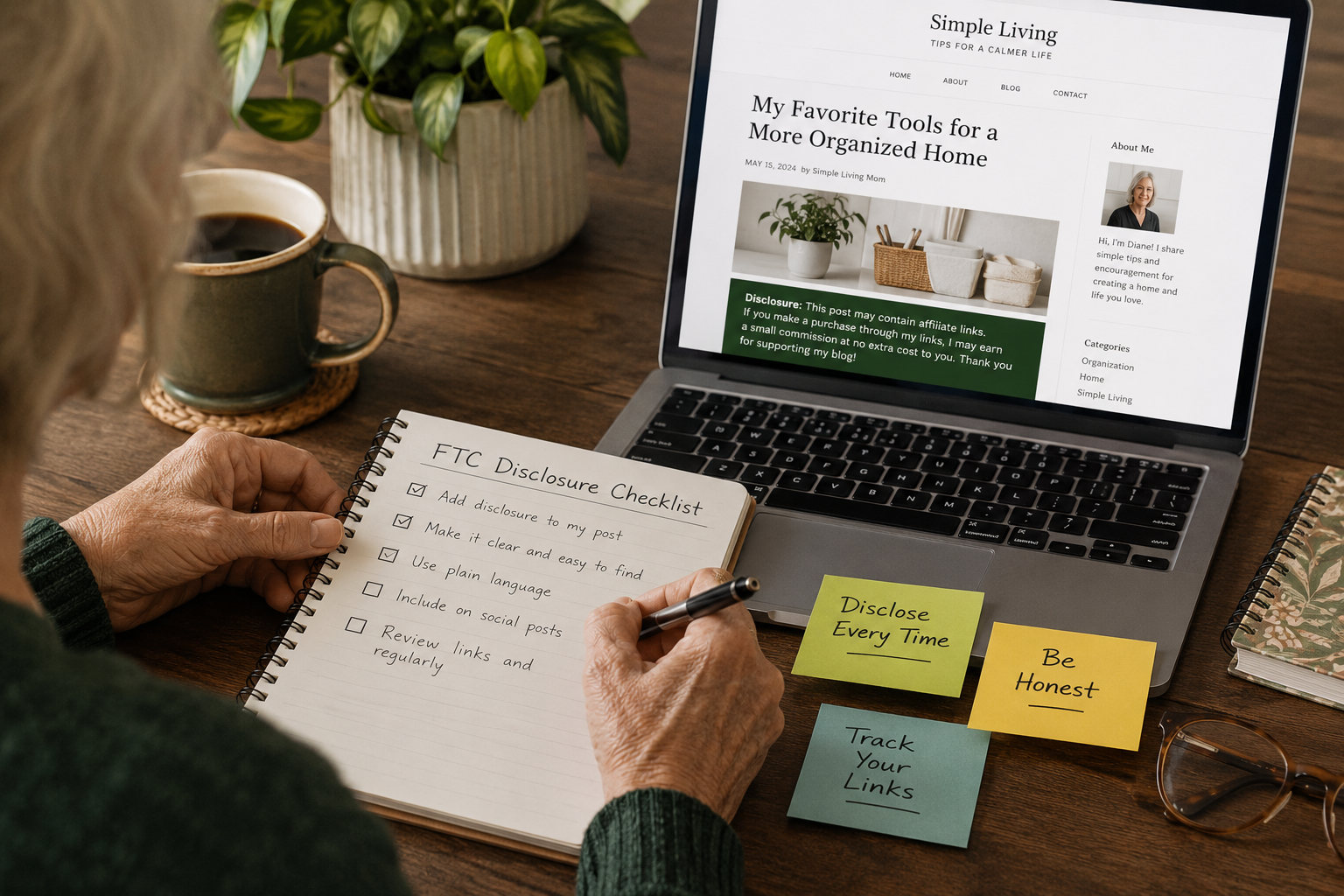
The Federal Trade Commission requires that you clearly disclose any affiliate relationship every time you share an affiliate link. That means:
- A disclosure at the top of every blog post containing affiliate links
- A verbal disclosure at the start of every video
- A clear statement in every email containing affiliate links
Research confirms that many content creators fail to disclose affiliate relationships adequately [6]. Don’t be one of them. The FTC has issued fines and warning letters. More importantly, your readers deserve to know.
A simple disclosure works fine: “This post contains affiliate links. If you purchase through these links, I may earn a small commission at no extra cost to you.”
That’s it. Plain English. Honest. Done.
AI Tools: Your Unfair Advantage (Used Wisely)
AI tools have made affiliate marketing significantly more accessible for people who aren’t professional writers or video editors.
What AI can help with:
- Drafting blog post outlines and first drafts
- Generating video script ideas
- Suggesting keywords and topic ideas
- Editing for clarity and grammar
- Optimizing content for search engines [3]
What AI cannot replace:
- Your personal experience with a product
- Your honest opinion
- Your relationship with your audience
Use AI as a research assistant and writing helper — not as a replacement for your own voice. Readers who trust you are trusting you, not a robot. AI-generated content that lacks personal insight is easy to spot and easy to ignore [3].
Tested and approved approach: Write the first draft yourself based on your real experience. Then use an AI tool to tighten the language, check for gaps, and suggest improvements. That combination outperforms either approach alone.
Realistic Income Expectations
Honest numbers matter here.
| Stage | Timeline | Realistic Monthly Income |
|---|---|---|
| Getting started | Months 1–3 | $0–$50 |
| Building traction | Months 4–9 | $50–$300 |
| Established presence | Month 10–18 | $300–$1,000+ |
| Scaled operation | Year 2+ | $1,000–$5,000+ |
These are realistic ranges, not guarantees. Results depend heavily on niche, consistency, and content quality.
Affiliate marketing is supplemental income, not a lottery ticket. For most seniors, the realistic goal is an extra $300–$800/month within 12–18 months of consistent effort. That’s meaningful money — enough to cover a utility bill, a car payment, or a trip to see the grandkids.
What to watch out for: Any program promising $10,000/month in 90 days is a scam. Walk away.
Common Mistakes to Avoid
- Promoting products you haven’t used — Readers notice. Trust, once lost, doesn’t come back.
- Choosing a niche based on commission size alone — If you don’t care about the topic, your content will show it.
- Skipping the disclosure — Not worth the legal or reputational risk.
- Quitting too early — Six months of consistent effort with no income feels discouraging. Most people quit right before traction starts.
- Ignoring mobile users — More than half of web traffic comes from mobile devices [4]. Make sure your blog and links work on a phone.
Conclusion: The Bottom Line
Affiliate marketing is one of the most legitimate ways for seniors to earn supplemental income online in 2026. It rewards experience, honesty, and patience — three things most people over 60 have in abundance.
It is not fast. It is not passive at the start. And it won’t make you rich overnight.
But done right — with a focused niche, honest content, proper disclosures, and consistent effort — it can generate real, meaningful income on your own schedule, from your own home.
Your actionable next steps:
- ✅ Pick one niche you genuinely know and care about
- ✅ Set up a simple blog or YouTube channel this week
- ✅ Apply to Amazon Associates or one relevant affiliate program
- ✅ Write or record your first honest product review
- ✅ Add your FTC disclosure before you publish anything
- ✅ Commit to publishing one piece of content per week for six months
That’s the whole plan. No secrets. No shortcuts. Just honest work with real upside.
References
[1] Top 6 Affiliate Marketing Trends To Look Out For – https://news.digistore24.com/en/top-6-affiliate-marketing-trends-to-look-out-for?utm_source=openai
[2] State Of Affiliate Marketing 2026 3 – https://www.affiliatebooster.com/state-of-affiliate-marketing-2026-3/?utm_source=openai
[3] Affiliate Marketing Trends 2026 – https://commissiondex.com/blog/affiliate-marketing-trends-2026/?utm_source=openai
[4] Top 8 Affiliate Trends 2026 – https://embryo.com/blog/top-8-affiliate-trends-2026/?utm_source=openai
[5] Niches 2023 – https://www.serplogic.com/all-things-marketing/niches-2023/?utm_source=openai
[6] arxiv – https://arxiv.org/abs/2603.04383?utm_source=openai
[7] Cpa Marketing Trends 2026 – https://www.affburg.com/blog/cpa-marketing-trends-2026?utm_source=openai
[8] Affiliate Marketing Trends 2026 – https://affiliategravity.com/affiliate-marketing-trends-2026/?utm_source=openai