Last updated July 2, 2026
Heads up: this post contains affiliate links. If you buy through them I may earn a small commission at no extra cost to you. I only recommend what I’ve used or genuinely evaluated. Full disclosure here.
More than half of all Americans ran into a scam attempt at least once a month in 2025 — and the numbers are getting worse, not better [1]. For adults 60 and older, the stakes are even higher. Seniors lost over $931 million in a single year to the top ten financial scams alone [2]. In 2026, the threat has grown sharper thanks to artificial intelligence tools that make fake calls, fake faces, and fake emergencies nearly impossible to spot without knowing what to look for.
This article covers the online scams targeting seniors in 2026 in plain English — no hype, no scare tactics. Just what’s happening, why it works, and exactly what you can do about it.
Key Takeaways
- 🔴 Over half of Americans faced scam attempts monthly in 2025 — and AI is making those attempts more convincing in 2026.
- 💸 Seniors lose hundreds of millions each year to romance scams, government impersonation, and tech support fraud.
- 🤖 AI voice cloning and deepfakes are the fastest-growing new tools scammers use against older adults.
- 📱 Social media platforms — especially Facebook — are now primary hunting grounds for fraudsters.
- 🛡️ Simple habits and family conversations are still the most effective defense.
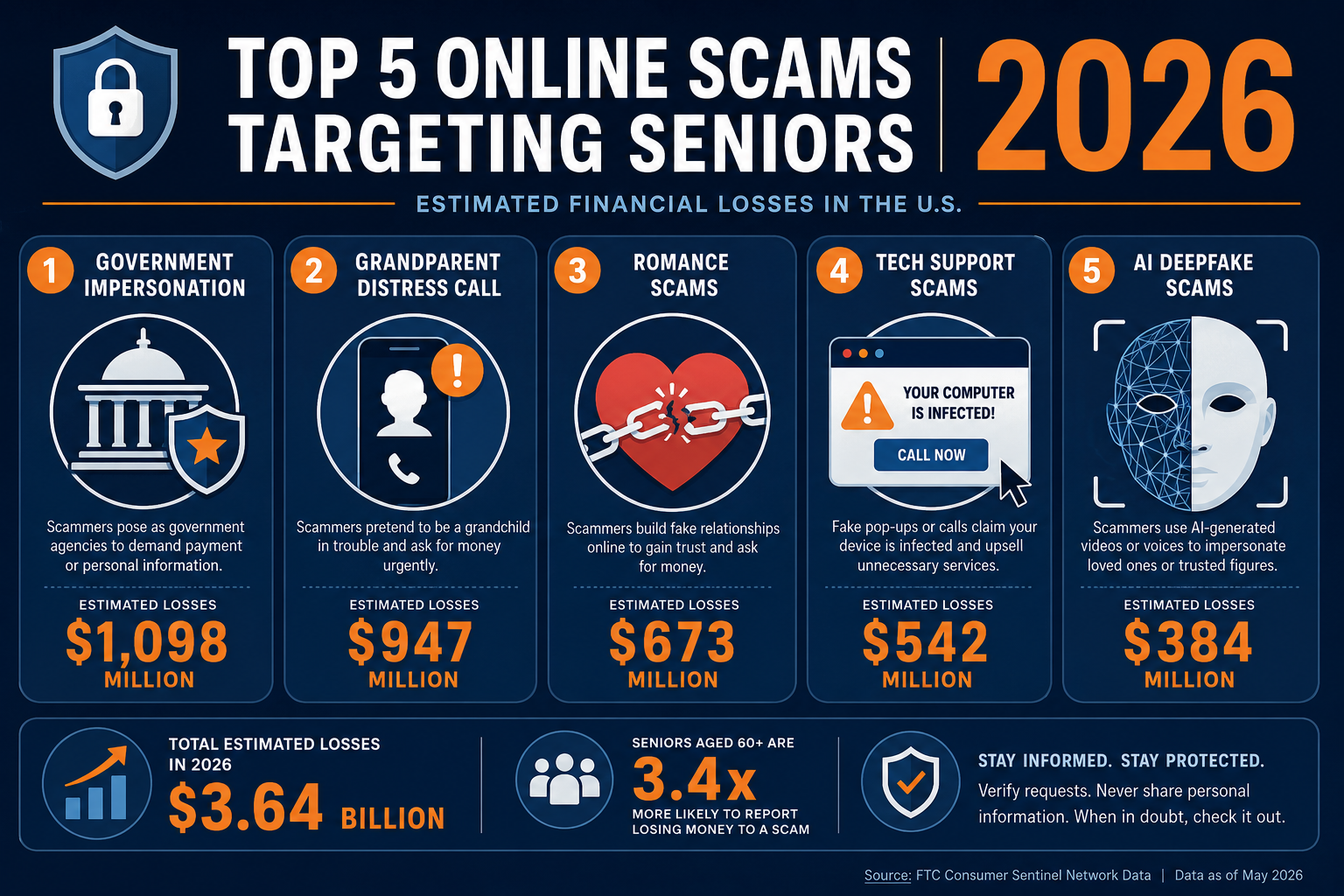
The Scams You’re Most Likely to Encounter in 2026
Online scams targeting seniors in 2026 aren’t random. They follow predictable patterns. Knowing the playbook is the first line of defense.
1. Government Impersonation Scams
A caller says they’re from Medicare, Social Security, or the IRS. They claim your benefits are suspended, your account has been flagged, or you owe back taxes. They want your Social Security number — right now — or something bad will happen.
The truth: No government agency will ever call you out of the blue and demand personal information or immediate payment [3]. Not Medicare. Not Social Security. Not the IRS.
If you get one of these calls, hang up. Then call the agency directly using the number on their official website.
2. Grandparent Scams
Your phone rings. Someone says, “Grandma? It’s me — I’m in trouble.” They claim to be in jail, in a hospital, or stranded overseas. They beg you not to tell anyone and ask you to wire money immediately [3].
This works because it hits hard emotionally. You want to help your grandchild. The scammer counts on that.
What to do: Hang up and call your grandchild directly on the number you already have saved. Don’t call back the number that called you.
3. Romance Scams
Scammers create fake profiles on dating sites or social media. They build trust over weeks or months. Then comes the request — money for a plane ticket, a medical emergency, a business deal gone wrong [3].
The FTC found seniors lost $213 million to romance scams in a single year [2]. These aren’t quick cons. Some go on for months. The emotional damage is as real as the financial loss.
What to watch out for: Someone you’ve never met in person who asks for money in any form — wire transfer, gift cards, cryptocurrency — is almost certainly running a scam.
4. Tech Support Scams
A popup appears on your screen. It says your computer is infected. It gives you a number to call. You call, and a “Microsoft” or “Apple” technician offers to fix the problem — for a fee, and with remote access to your computer [4].
Once they have remote access, they can steal passwords, banking information, and personal files.
The rule: Legitimate tech companies don’t send unsolicited popups asking you to call them. Close the window. Don’t call the number.
5. Social Media Fraud
Facebook, YouTube, and Instagram are now common venues for scams targeting older adults [7]. These include:
- Fake friend requests from people pretending to be someone you know
- Fraudulent ads for products that don’t exist
- Phishing links disguised as news stories or giveaways
Plain English rule: If an ad or message on social media seems too good to be true, it is. Every single time.
| Scam Type | Common Delivery Method | What They Want |
|---|---|---|
| Government Impersonation | Phone call, email | SSN, bank info, payment |
| Grandparent Scam | Phone call | Wire transfer, gift cards |
| Romance Scam | Dating sites, Facebook | Money, gift cards, crypto |
| Tech Support Scam | Popup, phone call | Remote access, payment |
| Social Media Fraud | Facebook, Instagram | Personal data, money |
The New Threat: AI, Voice Cloning, and Deepfakes
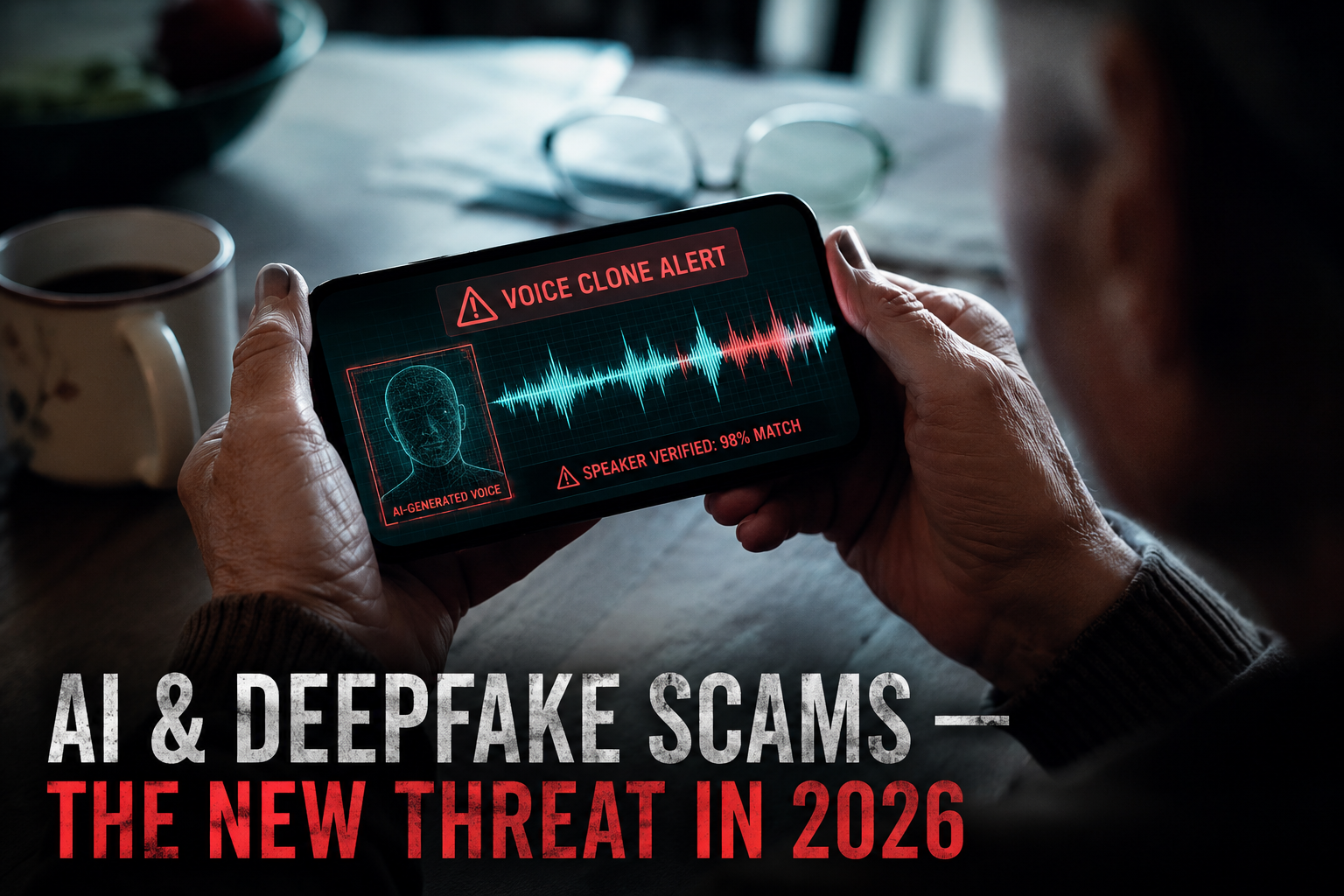
This is where online scams targeting seniors in 2026 have taken a genuinely dangerous turn.
Voice Cloning
Scammers can now use artificial intelligence to clone a person’s voice from just a few seconds of audio — audio they can get from a voicemail, a social media video, or a public recording [6]. They use that cloned voice to call you and pretend to be your grandchild, your doctor, or even your bank.
You hear what sounds exactly like your grandson’s voice saying he’s in trouble. That’s not a trick you can easily see through in the moment.
What helps: Agree on a family code word in advance. Something simple that only your family knows. If someone calls claiming to be a family member in an emergency, ask for the code word. A scammer won’t have it.
Deepfake Video
AI can now generate convincing video of real people saying things they never said. Researchers studying these threats have found that traditional fraud detection methods are becoming less effective as deepfake technology improves [5].
You might see a video of a well-known figure — a doctor, a financial advisor, even a celebrity — endorsing a product or investment. The video looks real. It isn’t.
The rule: Don’t make financial decisions based on video content alone, especially on social media.
Why Seniors Are Specifically Targeted
It’s not because older adults are less intelligent. Research shows it comes down to a few practical factors:
- More savings accumulated over a lifetime
- More trust in authority figures and institutions
- Less familiarity with how AI tools work
- More isolation, which makes emotional manipulation easier
Scammers are running a numbers game. They go where the money is and where the defenses are weakest.
How to Protect Yourself: A Plain-English Action Plan
One more layer worth having: a VPN scrambles your internet connection so no one can snoop on what you’re doing — especially on public Wi-Fi. NordVPN is the one I use, and it now bundles antivirus and monitoring too.
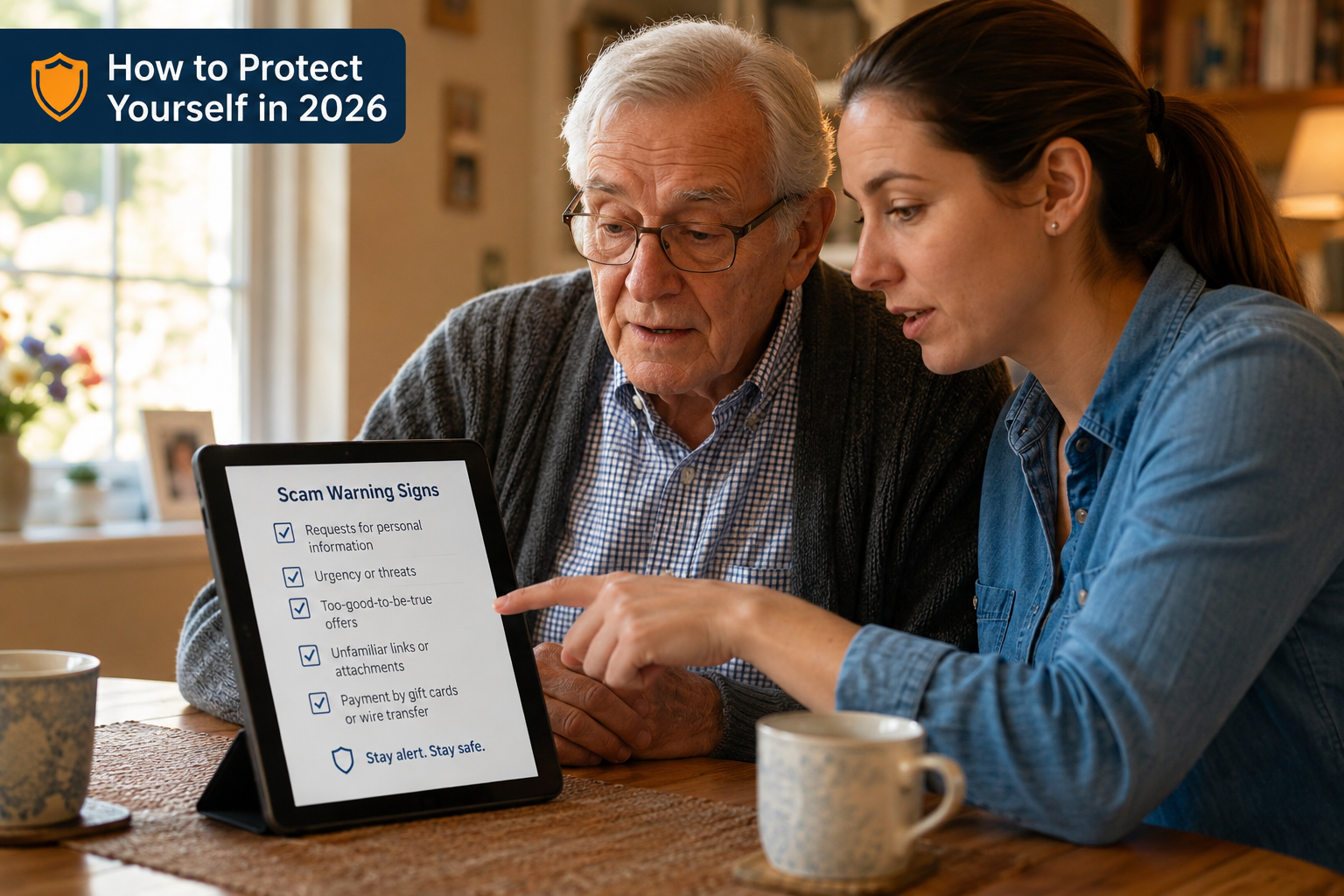
No product or app will protect you completely. But these habits — practiced consistently — make you a much harder target.
🔒 The Core Habits
1. Slow down before you act. Every scam depends on urgency. “Act now or lose your benefits.” “Send money today or your grandson goes to jail.” Real emergencies don’t require you to make financial decisions in five minutes. If someone is pushing you to act fast, that’s the scam.
2. Verify independently. Got a call from your bank? Hang up and call the number on the back of your card. Got an email from Medicare? Go directly to Medicare.gov — don’t click the link in the email.
3. Never give out personal information to an inbound caller. You didn’t call them. You don’t know who they are. Social Security numbers, bank account numbers, and Medicare ID numbers are not for sharing over the phone with someone who called you.
4. Use a family code word. Set up a simple code word with close family members for emergency situations. This takes about two minutes and can stop a voice-cloning scam cold.
5. Talk to someone before sending money. Any time someone asks you to send money — especially by wire transfer, gift card, or cryptocurrency — talk to a trusted family member or friend first. Scammers specifically tell you not to tell anyone. That’s a red flag, not a reason to comply.
🛡️ Tools That Actually Help
- Call-blocking apps like Nomorobo or Hiya filter known scam numbers
- Two-factor authentication on email and banking accounts adds a second lock
- Credit freezes at all three bureaus (Equifax, Experian, TransUnion) prevent new accounts from being opened in your name — free to set up and lift
For a fuller walkthrough of the newest AI scams and how to spot them, see our step-by-step guide to spotting AI-powered scams. And if you are considering a paid monitoring service, here is what to look for in an identity protection service before you sign up.
👨👩👧 The Role of Family
Research shows that involving younger family members in scam education significantly improves resilience against AI-driven fraud [5]. Role-based simulations — where seniors actually walk through fraud scenarios as the victim or observer — have been shown to sharpen the ability to spot scams in real situations [8].
In plain English: talk to your kids and grandkids about this. Not because you can’t handle it alone, but because scammers are using technology that even tech-savvy younger adults find convincing.
What to Do If You’ve Been Scammed
First: you are not alone and you are not stupid. These scams are designed by professionals to fool smart people.
- Stop contact with the scammer immediately
- Contact your bank — some transfers can be reversed if caught quickly
- Report it to the FTC at ReportFraud.ftc.gov
- Report it to your state attorney general’s office
- Tell someone you trust — shame keeps people from reporting, and reporting helps protect others
The U.S. Attorney’s Office actively warns about and prosecutes scams targeting seniors [9]. Reporting matters.
Conclusion: The Bottom Line on Online Scams Targeting Seniors in 2026
If you’d rather have one service handle the monitoring for you, Aura is the identity protection service I recommend — it covers credit and bank monitoring, dark-web alerts, and identity theft insurance.
The threat is real and it’s growing. Online scams targeting seniors in 2026 are more sophisticated than ever, thanks to AI tools that can fake voices, faces, and official-looking communications.
But the defenses are also straightforward.
Slow down. Verify independently. Use a family code word. Never send money to someone you haven’t met in person. These four habits will stop the vast majority of scams before they do any damage.
No app, no product, and no article will make you completely immune. But knowing what to watch out for — and having a plan before the call comes — puts you in a far stronger position than most people.
Stay skeptical. Stay informed. And if something feels off, it probably is.
References
[1] Scams Are Getting So Much More Efficient New Study Warns Over Half Of Americans Hit By Fraud In 2025 And The Figure Is Only Going To Get Worse – https://www.techradar.com/pro/security/scams-are-getting-so-much-more-efficient-new-study-warns-over-half-of-americans-hit-by-fraud-in-2025-and-the-figure-is-only-going-to-get-worse?utm_source=openai
[2] Financial Schemes Target Senior Citizens – https://legal.thomsonreuters.com/en/insights/articles/financial-schemes-target-senior-citizens?utm_source=openai
[3] Common Scams Targeting Senior Citizens – https://www.centralbank.net/learning-center/common-scams-targeting-senior-citizens/?utm_source=openai
[4] Scams Targeting Seniors – https://www.regions.com/insights/wealth/article/scams-targeting-seniors?utm_source=openai
[5] arxiv (AI and Deepfake Scam Research) – https://arxiv.org/abs/2508.11579?utm_source=openai
[6] Five Scams Impacting Older People And How To Fight Back – https://theweek.com/personal-finance/five-scams-impacting-older-people-and-how-to-fight-back?utm_source=openai
[7] Financial Scams Targeting Seniors 65+ – https://65pluslife.com/fiancial-scams-targeting-seniors-65/?utm_source=openai
[8] arxiv (Role-Based Simulation Research) – https://arxiv.org/abs/2601.12324?utm_source=openai
[9] US Attorneys Office Warns Scams Targeting Seniors – https://www.justice.gov/usao-ndoh/pr/us-attorneys-office-warns-scams-targeting-seniors?utm_source=openai