Last updated August 23, 2026
Heads up: this post contains affiliate links. If you buy through them I may earn a small commission at no extra cost to you. I only recommend what I’ve used or genuinely evaluated. Full disclosure here.
Legacy Income Academy is a free newsletter for adults over 50 — plain English about money, AI, and the things that quietly cost you money if nobody tells you. Join free. No hype, ever.

Research-Based Review | Legacy Income Academy | Updated 2026
Disclosure: Some links in this article are affiliate links. If you click one and make a purchase, Legacy Income Academy may earn a commission — at no extra cost to you. This does not influence our recommendation. Aura was evaluated against LIA’s editorial standards.
Adults over 60 lose more money to identity theft than any other age group — and the gap is widening. According to the FTC, older Americans are targeted more often and recover less of what’s stolen. So when a service like Aura promises all-in-one protection, it’s worth asking: does it actually deliver, or is it just another subscription draining your bank account?
This Aura identity protection review cuts through the marketing language. No hype. No scare tactics. Just an honest look at what Aura does, what it costs, who it helps, and where it falls short — so you can make a clear-eyed decision.
Key Takeaways
Aura bundles more features than most competitors at a comparable price — credit monitoring, antivirus, VPN, and data removal are all included.
The $1 million insurance policy sounds impressive but comes with conditions. Read the fine print before assuming you’re fully covered.
Best for seniors who want one service to handle multiple digital security needs without juggling separate subscriptions.
Not ideal if you only want basic credit monitoring and don’t need the extras.
A 60-day money-back guarantee makes it low-risk to test before committing annually. [2][4] Current Aura plans and pricing are here.
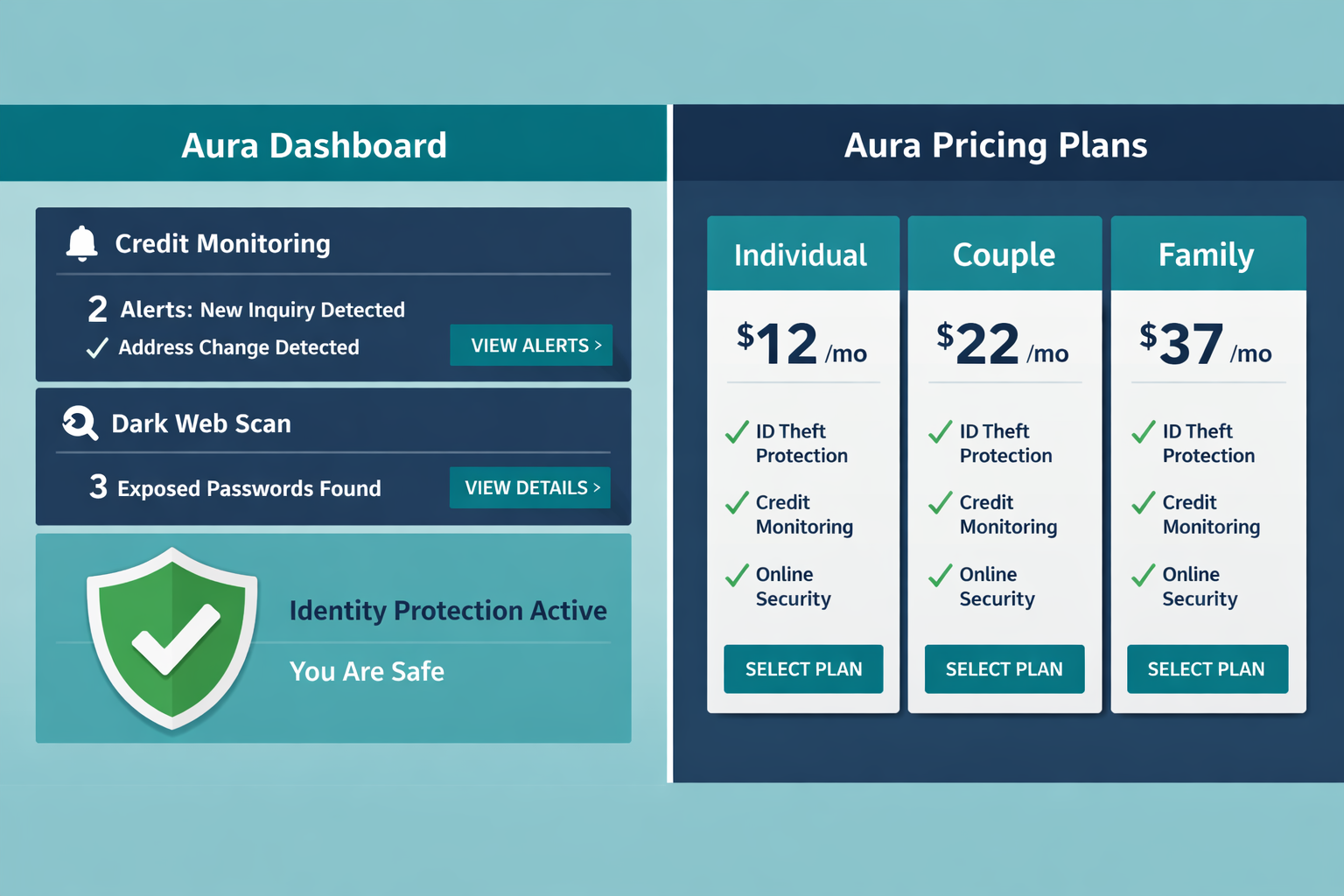
What Aura Actually Does — Plain English Breakdown
Aura markets itself as an “all-in-one” digital safety platform. That claim holds up better than most. Here’s what you actually get when you sign up.
Credit and Financial Monitoring
Aura monitors all three major credit bureaus — Equifax, Experian, and TransUnion — in real time and sends fraud alerts when something changes. [4] That’s important because some services only monitor one bureau, which means two-thirds of your credit activity goes unwatched.
Beyond credit, Aura watches for suspicious activity tied to your Social Security number, bank accounts, and investment accounts.
Dark Web Monitoring
Your personal information — email addresses, passwords, Social Security numbers — can end up on dark web marketplaces after a data breach. Aura scans over 130 pieces of personally identifiable information across these sites and alerts you if your data appears. [4]
This matters more than most people realize. Data breaches at retailers, hospitals, and financial institutions happen constantly. Knowing your information is circulating gives you time to act before damage is done.
Data Removal Service
This is one of Aura’s more underappreciated features. Data brokers are companies that collect and sell your personal information — your name, address, phone number, relatives, and more. Aura submits removal requests to over 200 data broker and people-search sites, plus Google search results and junk mail lists. [5]
For seniors, this is genuinely useful. Reducing the amount of personal data floating around online lowers the chances of being targeted by scammers in the first place. You can also do this yourself for nothing, one site at a time — we walk through how to remove your personal information from the internet by hand.
Home and Auto Title Monitoring
Aura monitors for fraudulent transactions involving your home or vehicle title. [5] Property title fraud — where someone forges documents to transfer ownership of your home — is a real and growing crime. Most identity protection services don’t cover this at all.
Security Software Bundle
Every Aura plan includes antivirus protection, a VPN (virtual private network), a password manager, anti-tracking tools, an ad blocker, and email aliases. [1] These tools are not available separately — they come as a package. If the password manager is the piece you actually want, compare it against the standalone password managers we rate for seniors first.
What that means for you: Instead of paying for Norton antivirus, a separate VPN, and a password manager, Aura bundles all of it. Whether you need all of it is a fair question — but the value is real if you do.
$1 Million Identity Theft Insurance
Every plan includes identity theft insurance underwritten by a third-party insurer. The coverage amount depends on your plan level. [1][4]
One honest note here: Insurance like this typically covers out-of-pocket expenses related to restoring your identity — legal fees, lost wages, and similar costs. It does not automatically replace stolen money from your bank account. Read the policy terms carefully before assuming full coverage.
Aura Pricing — What You’ll Actually Pay in 2026
Pricing is straightforward. Here’s the current breakdown:
PlanMonthly BillingAnnual BillingAdults CoveredDevicesInsuranceIndividual$12/mo$9/mo110$1MCouple$20/mo$17/mo220$2MFamily$30/mo$25/moUp to 5 (or 10)50$5MKids Add-On$13/mo—Children——
Sources: [1][3][5]
A few things worth noting:
Annual billing saves real money. The individual plan drops from $144/year to $108/year — a $36 savings.
The Family plan covers 5 adults plus unlimited children under 18 living in the same household — solid value for households protecting multiple generations.
The Kids plan at $13/month includes specialized protections for younger users. [2] If grandchildren are in the picture, this is worth knowing about.
Annual plans come with a 60-day money-back guarantee. [2][4] That’s a meaningful safety net.
Who Aura Is Best For
Aura works best for a specific type of person. Here’s a plain-English breakdown.
✅ Good fit if you:
Want one subscription to cover credit monitoring, antivirus, VPN, and data removal — instead of three or four separate services
Have a spouse or adult children you want to protect under the same plan
Own a home and want title fraud monitoring included
Are comfortable using a smartphone or computer to receive alerts (basic tech comfort required)
Want a 60-day window to test the service before fully committing
I’m past full retirement age myself — exactly the audience Aura is built for. The feature that got my attention wasn’t the credit monitoring — it was the data broker removal. Most people don’t realize how much of their personal information is already out there being sold.
❌ Not a good fit if you:
Only want basic credit monitoring and have no interest in the security software features
Prefer a simpler, cheaper service with fewer moving parts
Are not comfortable managing app-based alerts and notifications
Already pay separately for antivirus and a VPN and are locked into those contracts
What to Watch Out For
Every honest review has to include the downsides. Here are the ones that matter most.
1. It’s a Lot of Features — Which Can Feel Overwhelming
Aura packs a lot into one subscription. For someone who just wants to know if their credit changed, the full dashboard can feel like too much. The setup process requires some patience and basic tech comfort.
2. The Insurance Has Conditions
The $1 million insurance figure gets used heavily in Aura’s marketing. What it actually covers is more limited — primarily the costs of recovering from identity theft, not direct reimbursement of stolen funds. [4] That’s still valuable, but it’s not a blank check.
3. Data Removal Takes Time
Aura’s data removal service submits requests to data brokers, but brokers aren’t required to comply instantly. Some removals take weeks. And brokers can re-add your information over time, requiring ongoing maintenance. [5] It works — but it’s not instant.
4. Price Creep on Monthly Billing
If you choose monthly billing and forget to cancel, costs add up. The individual plan at $12/month is $144/year. Committing to annual billing upfront is the smarter financial move if you decide to stay.
The Data Privacy Angle — What Aura Knows About You
This is a fair question that doesn’t get asked enough: What does Aura do with your personal data?
To monitor your credit, dark web activity, and data broker listings, Aura needs access to sensitive information — your Social Security number, financial accounts, and personal details. That’s unavoidable with any identity protection service.
Aura states it does not sell your personal data to third parties. The company is based in the United States and is subject to U.S. privacy laws. Their privacy policy is publicly available and worth reading before you sign up. The same scepticism is worth applying to any unexpected message claiming to be from a protection service — our list of online scam red flags covers what those look like.
The honest reality: any service that monitors your identity requires you to share that identity with them. That’s a trade-off. The question is whether you trust the company more than you trust doing nothing. Given Aura’s track record and independent reviews from sources like NerdWallet [2] and SafeHome.org [3], the consensus is that the trade-off is reasonable — but it’s your call to make.
How Aura Compares to Competitors
Weighing Aura against other services? See our guide to what to look for in an identity protection service before you sign up.
This Aura identity protection review wouldn’t be complete without a quick comparison.
| Feature | Aura | LifeLock (Norton 360) | Identity Guard |
|---|---|---|---|
| Credit monitoring | All 3 bureaus (every plan) | 3 bureaus (higher tiers) | 3 bureaus |
| Dark web scanning | Yes | Yes | Yes |
| VPN included | Yes | Yes (Norton 360) | No |
| Antivirus included | Yes | Yes | No |
| Identity theft insurance | $1M per adult | $1M–$3M (varies by tier) | $1M |
| U.S. support | 24/7 | 24/7 | Business hours |
| Starting price (individual) | ~$12/mo (~$9 billed annually) | ~$9/mo (basic) | ~$7/mo (basic) |
| Family plan value | Strong | Moderate | Moderate |
Aura vs. LifeLock: LifeLock is the most recognized name in the space, but Aura generally offers more features at a lower price point. LifeLock’s higher tiers cost significantly more and don’t always include the full security software bundle Aura provides. [4][6]
Aura vs. Identity Guard: Worth noting — Aura acquired Identity Guard, so these are sister products under the same parent company. They remain distinct services with different pricing tiers. Identity Guard has a lower entry price, but Aura’s data removal service and title monitoring give it an edge for seniors who want broader coverage. [9]
The bottom line on comparisons: Aura isn’t the cheapest option on the market. It’s also not the most expensive. It sits in a middle range where the feature-to-price ratio is genuinely competitive — especially for seniors who want more than just credit monitoring.
The Bottom Line — Is Aura Worth It for Seniors?
My take: For most seniors who want monitoring, alerts, and identity-recovery support in one place, Aura is the service I’d recommend — and the 60-day money-back guarantee makes it low-risk to try. You can check Aura’s current plans and pricing here.
Here’s the straight answer: Yes, for the right person.
If you want one service that covers credit monitoring across all three bureaus, dark web scanning, data broker removal, antivirus, VPN, and title fraud protection — Aura delivers all of that in a single subscription. The pricing is fair, the insurance adds a safety net, and the 60-day money-back guarantee makes it low-risk to try. [2][4]
If you only want basic credit monitoring and nothing else, there are cheaper options. Aura’s value comes from the bundle. If you’re not going to use the security software features, you’re paying for things you don’t need.
For most seniors who are serious about protecting their identity and digital life in 2026, Aura is worth a serious look.
Conclusion — Next Steps Worth Taking
Identity theft isn’t going away. If anything, the tactics scammers use are getting more sophisticated. Taking action now — before something goes wrong — is always smarter than scrambling after the fact.
Here’s what to do if you’re considering Aura:
Start with the 60-day money-back guarantee. [2] Sign up for an annual plan and you have 60 days to decide if it’s worth it.
Check what you’re already paying for. If you have separate antivirus, VPN, or credit monitoring subscriptions, calculate whether Aura’s bundle would actually save you money.
Read the insurance terms. Before assuming you’re covered for $1 million, understand what the policy actually reimburses.
Consider the Family plan if you have a spouse or adult children you want to protect. The per-person cost drops significantly. [3]
If you try it and it’s not for you, cancel within 60 days of an annual subscription for a full refund. [4]
No service is perfect. But Aura is honestly reviewed, fairly priced, and built with a feature set that makes real sense for adults who want comprehensive protection without managing five separate subscriptions. If you want to see where the plans stand today, Aura’s current pricing page is here.
FAQ
Does Aura actually get my information off data broker sites?
It submits removal requests on your behalf to a large list of broker and people-search sites. Brokers are not required to act instantly, some removals take weeks, and brokers can re-add your details later, so it is ongoing maintenance rather than a one-time fix.
Is the one million dollar insurance real coverage?
It is real, but narrower than the headline suggests. It is aimed at the costs of recovering from identity theft, such as legal fees and lost wages. It does not automatically reimburse money taken out of your bank account. Read the policy terms before you rely on it.
Can I use Aura if I have already frozen my credit?
Yes, and the two work well together. A freeze stops new accounts being opened in your name. Monitoring tells you about the fraud a freeze does not block, such as misuse of your Social Security number or your details showing up after a breach.
What will Aura cost me after the first year?
There is no permanent introductory rate quoted in the pricing this review is based on. Annual billing is the cheaper route at every plan level, and monthly billing is where the cost quietly adds up. Check current pricing on Aura’s own site before you commit, since plan prices change.
Do I still need Aura if I already pay for antivirus and a password manager?
Probably not at full value. Aura’s case rests on the bundle. If you are already locked into separate antivirus, VPN or password manager subscriptions, you would be paying twice for part of it until those renew.
What happens if I try it and decide it is not for me?
Annual plans carry a sixty-day money-back guarantee, so the first two months are effectively a trial. Cancel inside that window on an annual plan and you get a refund. Monthly billing does not carry the same guarantee.
Related Reading on Legacy Income Academy
- Identity Theft Protection for Retirees: Freeze, Lock, and Monitor Your Accounts
- Online Safety for Seniors: Spotting AI-Powered Scams
- What Is a VPN and Why Every Senior Should Have One
References
[1] Aura Identity Theft Price Now – https://allaboutcookies.org/aura-identity-theft-price-now
[2] Aura Review – https://www.nerdwallet.com/finance/learn/aura-review
[3] Aura – https://www.safehome.org/identity-theft-protection/aura/
[4] Aura Vs Lifelock – https://www.aura.com/learn/aura-vs-lifelock
[5] Pricing – https://www.aura.com/pricing
[6] Aura Vs Lifelock – https://cybernews.com/identity-theft-protection/aura-vs-lifelock/
[7] Lifelock Vs Aura – https://www.security.org/identity-theft/lifelock-vs-aura/
[8] Best Identity Theft Protection – https://money.com/best-identity-theft-protection/
[9] Identity Guard Vs Aura – https://www.cape.co/blog/identity-guard-vs-aura