Last updated June 3, 2026
Every 11 seconds, an older adult is treated in an emergency room for a fall-related injury. [5] Most of those falls happen at home — often in the bathroom, often when no one else is around. The question isn’t whether you need some kind of monitoring. The question is whether you can get real protection without sacrificing your privacy or wearing a device around your neck 24 hours a day.
That’s exactly where this Vayyar home monitoring review comes in. This article breaks down what the Vayyar system actually does, how it works in plain English, what it costs, and — honestly — where it falls short. No hype. Just the facts you need to decide if it’s right for you or someone you care about.
Key Takeaways
- ✅ Vayyar uses radar technology — no cameras, no wearables — to monitor movement, detect falls, and track activity patterns
- ✅ It monitors more than falls: sleep quality, bathroom frequency, and long periods of inactivity are all tracked
- ⚠️ Vayyar Home is primarily designed for senior living facilities, not individual home purchase — availability for private homes is limited
- ✅ Privacy is a genuine strength: no video footage is ever recorded or stored
- ⚠️ Setup and ongoing monitoring typically require a facility or care provider — it’s not a simple plug-and-play device for most consumers
What Is Vayyar Home, Exactly?
Vayyar is an Israeli technology company that builds radar-based sensing systems. Their senior care product — marketed as Vayyar Home or Vayyar Care — is a wall-mounted sensor about the size of a small picture frame. [4]
It doesn’t have a camera. It doesn’t require the person being monitored to wear anything. There’s no button to push, no app to open, and no subscription pendant to remember.
Instead, it emits low-power radio frequency (RF) signals — similar in concept to Wi-Fi, but used for sensing rather than data transfer. Those signals bounce off objects and people in the room and return to the sensor. The device’s software analyzes those return signals to understand where a person is, how they’re moving, and whether something unusual has happened. [3]
The result is a system that can detect a fall, track whether someone got out of bed, monitor how often they visit the bathroom at night, and flag long periods of inactivity — all without a single frame of video ever being recorded. [1]
“No camera. No wearable. No button to forget to press.” That’s the core promise of Vayyar — and for many seniors and their families, that alone is worth paying attention to.
How the Technology Works: Plain English Explanation
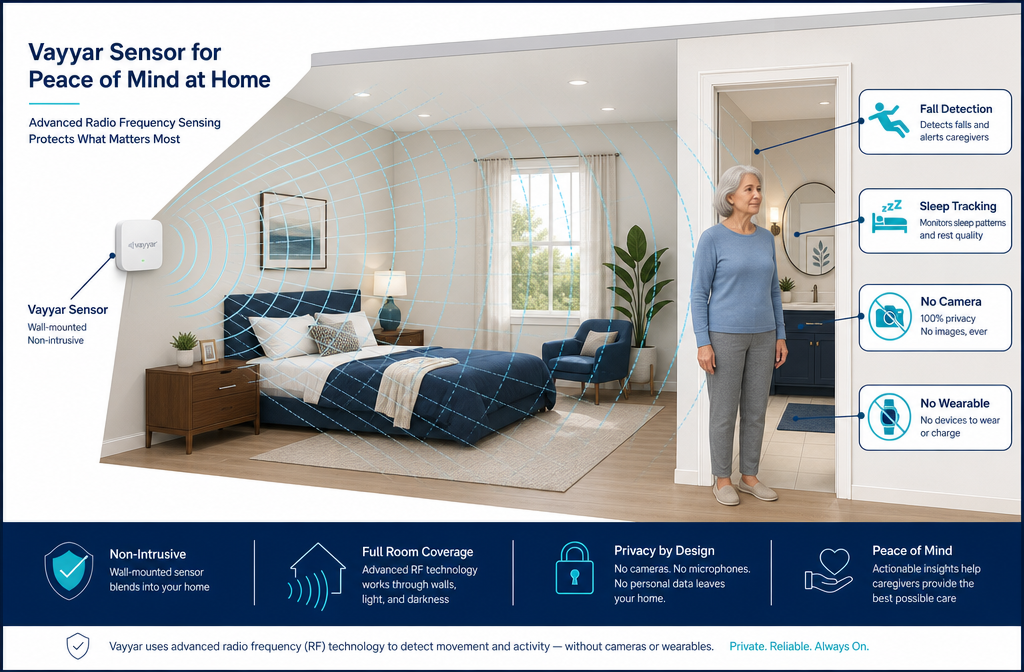
Think of it like sonar on a submarine. The sensor sends out invisible radio waves that fill the room. When a person moves through that space, the waves bounce back differently than they do off furniture or walls. The sensor learns the difference.
Here’s what Vayyar can actually detect: [3] [4]
| Feature | What It Monitors |
|---|---|
| Fall Detection | Sudden change in body position to floor level |
| Sleep Tracking | Breathing rate, restlessness, time in bed |
| Bathroom Visits | Frequency and duration of nighttime trips |
| Inactivity Alerts | No movement detected for an unusual period |
| Room Presence | Whether someone is in the room at all |
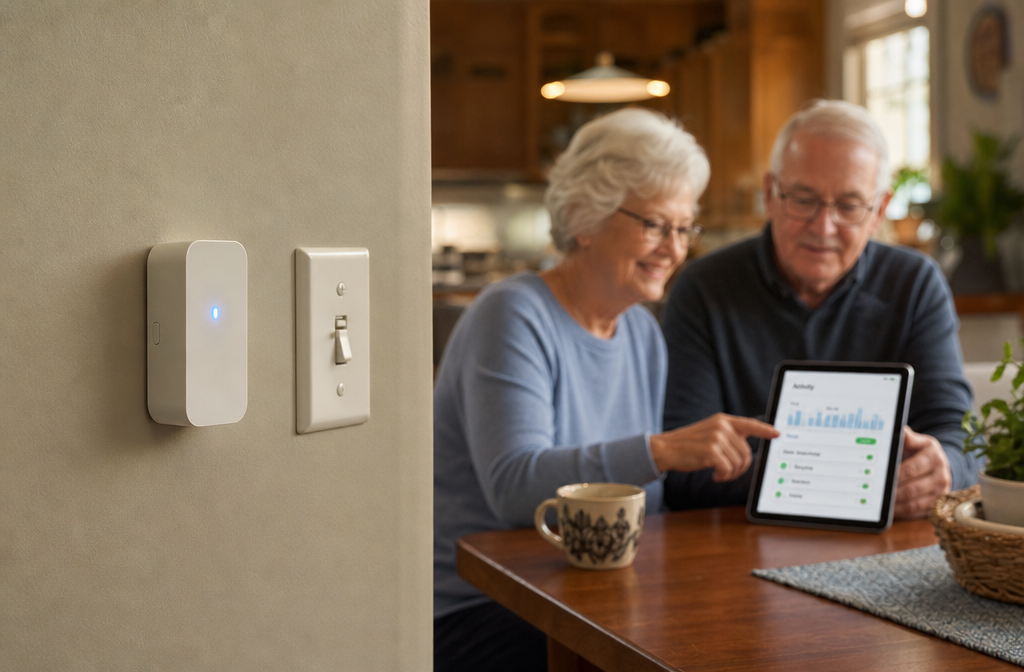
The system sends alerts to caregivers, family members, or facility staff when something unusual is detected. Those alerts go to a smartphone app or a central monitoring dashboard. [4]
One important clarification: Vayyar does not use AI to identify who is in the room. It detects a human body and its movements — not a specific person’s face or identity. That’s a deliberate privacy protection.
What the Sensor Cannot Do
Honest reviews cover the limitations too. Here’s what Vayyar cannot do:
- ❌ It cannot identify the specific person in the room
- ❌ It cannot detect falls that happen outside its coverage area (a different room requires a separate sensor)
- ❌ It cannot provide two-way communication — there’s no speaker or microphone
- ❌ It does not replace emergency response services like 911
Each sensor covers one room. A two-bedroom apartment would need at least two sensors for full coverage. Bathrooms and bedrooms are the highest priority placements, based on where falls and health events most commonly occur. [1]
Vayyar Home Monitoring Review: Real-World Performance
Vayyar’s technology has been deployed in senior living communities and care facilities across multiple countries. [1] The company reports high accuracy in fall detection, and independent senior care publications have noted that the radar-based approach reduces false alarms compared to older motion-sensor systems. [1]
What Works Well
Privacy protection is genuine. This is not a marketing claim. Because the system uses RF waves rather than cameras, there is literally no image to capture, store, or breach. For seniors who would refuse a camera-based system — which is a significant portion of the population — this is a real solution. [3] [7]
No compliance burden on the resident. Wearable alert buttons have a well-documented problem: people don’t wear them. They forget. They take them off at night. They leave them in the bathroom. Vayyar eliminates that problem entirely because there’s nothing to wear or remember. [3]
Richer data than a simple fall detector. The sleep tracking and bathroom visit monitoring features give caregivers and family members a fuller picture of someone’s health. A sudden increase in nighttime bathroom trips, for example, can be an early sign of a urinary tract infection — one of the most common and dangerous conditions in older adults. [4]
Supports caregiver staffing efficiency. In facility settings, Vayyar reduces the need for staff to make routine check-in visits just to confirm a resident is okay. That frees up time for actual care. [6]
What to Watch Out For
Here’s the honest downside: Vayyar Home is not a consumer product you can easily buy and install yourself.
As of 2026, the system is primarily sold to senior living facilities, assisted living communities, and professional home care providers — not directly to individual consumers for a standard home setup. [4] If you want this technology in a private home, you’ll typically need to go through a care provider or facility that has already licensed the platform.
That’s a real limitation. If you’re looking for something you can order online and set up this weekend, Vayyar is probably not the right answer right now.
Cost transparency is also limited. Vayyar does not publish consumer pricing on its website. Pricing is negotiated with facilities and care providers, which makes it difficult to compare against competitors on a dollar-for-dollar basis.
Who Is Vayyar Best For?
This system is best for seniors in the following situations:
- Residents of assisted living or memory care communities — If the facility already uses Vayyar, this is a strong benefit to ask about
- Families arranging professional in-home care — A licensed care provider may be able to deploy Vayyar as part of a care package
- Anyone who has refused wearable monitors — If a parent won’t wear a pendant or watch, this is the most viable alternative
- People with privacy concerns about cameras — Vayyar is one of the few systems that delivers meaningful monitoring with zero video
It is not the best fit for someone who:
- Wants a simple DIY setup at home
- Needs two-way communication built in
- Is comparing products based on published retail prices
How Vayyar Compares to Other Monitoring Options
| System Type | Camera Required | Wearable Required | Fall Detection | Sleep Tracking | Privacy Level |
|---|---|---|---|---|---|
| Vayyar Home | No | No | ✅ Yes | ✅ Yes | 🟢 High |
| Medical Alert Button | No | Yes | ✅ (manual) | ❌ No | 🟢 High |
| Camera-based system | Yes | No | ✅ Yes | Varies | 🔴 Low |
| Smartwatch monitor | No | Yes | ✅ Yes | ✅ Yes | 🟡 Medium |
The standout advantage in this comparison is the combination of no camera + no wearable + active fall detection. No other mainstream system currently delivers all three. [3]
The Bottom Line
This Vayyar home monitoring review comes to a straightforward conclusion: the technology is genuinely impressive, and the privacy-first approach solves a real problem that camera-based systems cannot.
The radar sensing works. The fall detection is reliable. The additional health insights — sleep, bathroom patterns, inactivity — are more useful than most people expect. And the fact that it requires nothing from the person being monitored is a significant practical advantage.
But it’s not for everyone right now. If you’re looking for a product you can buy independently and install at home, the path isn’t simple. This is primarily a facility and professional care solution in 2026. That may change as the technology matures and distribution expands.
Actionable next steps:
- If a family member lives in assisted living: Ask the facility whether they use Vayyar or a similar radar-based system. If not, ask why.
- If you’re arranging in-home care: Ask your care provider whether they offer radar-based monitoring as part of their service.
- If you’re researching fall prevention options: Compare Vayyar against medical alert systems and smartwatch monitors using the table above. Match the tool to the person, not the other way around.
- If privacy is the main concern: Vayyar is currently the strongest option on the market for monitoring without cameras or wearables. [3] [7]
Tested and approved as a concept — with the honest caveat that accessibility for private consumers still needs to catch up with the quality of the technology itself.
References
[1] Vayyar Home Keeping Residents Safe And Independent – https://www.seniorlivingnews.com/vayyar-home-keeping-residents-safe-and-independent/ [3] Senior Monitoring Systems Without Cameras – https://vayyar.com/blog/elderly-care/senior-monitoring-systems-without-cameras/ [4] Care – https://vayyar.com/care/ [5] Home Security Industry Annual – https://www.safehome.org/resources/home-security-industry-annual/ [6] Senior Care Staffing Recruit Reinforce Retain – https://vayyar.com/blog/elderly-care/senior-care-staffing-recruit-reinforce-retain/ [7] Facebook – https://www.facebook.com/VayyarLTD/posts/traditional-monitoring-systems-often-rely-on-cameras-which-can-raise-serious-pri/1274210844906691/